
Guitars
Fender Stratocaster Ex Richie Sambora Masterbuilt JW Black
19000€
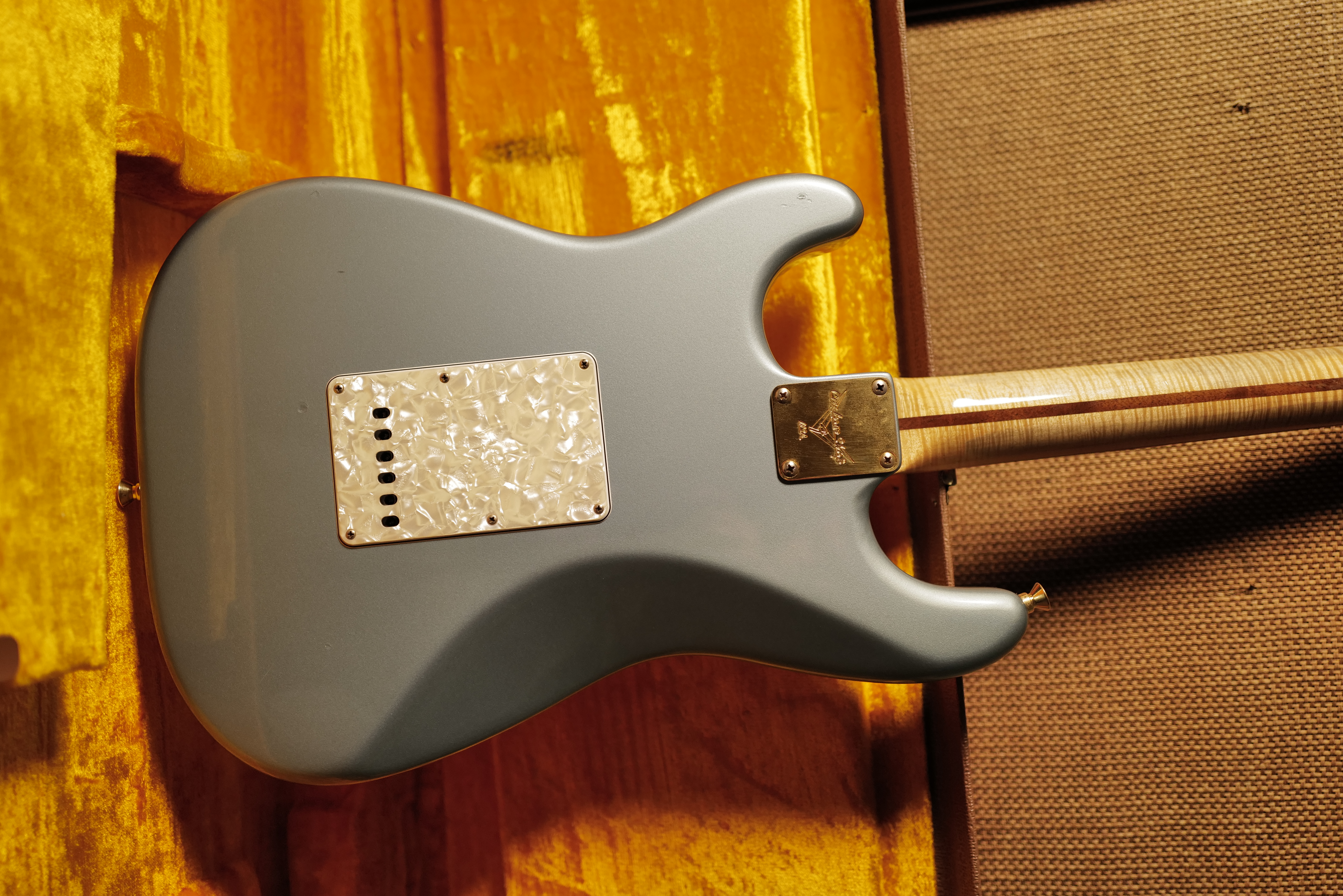
This 1996 Fender Custom Shop Eric Clapton Stratocaster, finished in Ice Blue Metallic and bearing serial number RS14, is an exceptional guitar that was stage-played by Richie Sambora during numerous live performances with Bon Jovi. The instrument was also signed by Richie Sambora in 2008, in black marker, featuring the personal inscription “Dave / Keep Pickin”.
This guitar was used for both recording and touring, most notably during the influential “Crush” tour, a defining period in Bon Jovi’s career. It can be seen in action during the live performance of “Next 100 Years”, filmed in Zurich in 2000, capturing Sambora in a powerful live setting.
The Stratocaster was also played at the 1996 VH1 All Star Garage Band Benefit Concert, alongside renowned artists including Bryan Adams, Paul Shaffer, Melissa Etheridge, and Eddie Van Halen, further cementing its place in rock history
Built by Master Builder J.W. Black at the Fender Custom Shop, this instrument features a heavily figured one-piece maple neck with a 25.5-inch scale length, 22 frets, black dot position markers, and a beautifully aged satin finish. Hardware includes six gold-plated staggered vintage-style tuners, reflecting the guitar’s premium craftsmanship.
The alder body is finished in a gently yellowed Ice Blue Metallic, paired with an aged white pearloid pickguard, white plastics, and a gold-plated tremolo bridge fitted with black Graph Tech saddles, along with a matching tremolo arm and output jack plate.
Electronics consist of three Lace Gold Sensor pickups, a five-way selector switch, master volume, TBX tone control, and a second tone knob controlling the on-board Clapton boost circuit, offering exceptional tonal flexibility.
The guitar is accompanied by its original brown Fender hardshell case with gold interior, as well as an old 9V battery marked “Clapton”. Two photographs are included, showing Richie Sambora posing with the signed guitar and playing it, providing strong visual confirmation of its provenance.
Richie Sambora
(1959)
Band : Bon Jovi
Main guitar : Fender Stratocaster signature
Compulsory listening : Livin’ On A Prayer
Such is the history of rock: for every Mick Jagger, there is a Keith Richards. For every Steven Tyler, there is a Joe Perry. For every Robert Plant, a Jimmy Page. For every superstar that gets the crowd going, there is a moody, infinitely cool guitar player that has the singer’s back and only takes the front of stage for quick assaults of thirty seconds.
Richie Sambora joined the New Jersey band Bon Jovi in 1983, a few months after its creation. Right from the start, Sambora’s playing and personality perfectly matched the image of founding singer Jon Bon Jovi. Together, they created a songwriting duo that would come up with hard rock classics that remain mainstays of every radio station playlist. The true explosion happened in 1986 with the Slippery When Wet album, on which Sambora co-wrote nine out of ten songs, including mega-singles Livin’ On A Prayer, You Give Love A Bad Name and Wanted Dead Or Alive. The guitar hero’s virtuosic, precise and energetic playing are in full force on that album. Sambora has integrated Van Halen’s influence to his style like any soloist of the time, but he added his personal twist to it. His talent for arranging can be head on the twelve-string parts of Wanted…, the pitch shifted solo to You Give Love A Bad Name or the talkbox for Livin’ On A Prayer.
After the release of the album, the band gets huge and starts touring around the world for sold-out crowds of entranced fans. Bon Jovi’s genius is that they achieved mainstream success at several points in their career, which makes them relevant to several generations of fans. They once again topped the charts with Always in 1994, then with It’s My Life (co-written by Sambora too) in 2000. That last song earned them a new audience that still follows them to this day.
A victim of his demons, Sambora had to quit the band in 2013 in the middle of one more world tour. Since then, he has launched the RSO band with his ex Orianthi. Over time, he seems more and more interested in the Telecaster and the Esquire, whereas he was the poster boy for superstrats in the glory days of Bon Jovi. Sambora’s musical future probably has a few great surprises in store.
Do you want to contact us or get more information about a particular guitar?